Juan Garcãƒâa Esquivel - to Love Again
- Built-in 20 January 1918, Tampico, Mexico
- Died 3 January 2002, Jiutepec, Morelos, Mexico
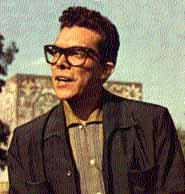 THE king of space-age pop. Esquivel'due south family moved to Mexico City in 1928, and by the early 1930s, he was actualization on radio station XEW. Self-taught as a histrion, composer, and arranger, he proved a prodigy, and was soon leading the station orchestra. By 1940, he had formed his own band, with 22 musicians and 5 vocalists. Much like Pedro Camacho, the soap opera author in Vargas Llosa's "Aunt Julia and the Scripwriter," Esquivel honed his writing and conducting abilities providing the background music for a daily radio prove starring the comedian Panseco. "He'd ask things similar 'Tin can you lot play something that sounds like a Russian guy walking through China?' and somehow, I would do information technology," Esquivel later recalled.
RCA contracted with Esquivel in late 1957, commencement releasing one of his Mexican albums in the U.S. as "To Love Once again." The label brought Esquivel to record in Hollywood in early on 1958. He was given v hours of studio time to tape the album ("Other Worlds, Other Sounds"), just he finished the task with ninety minutes to spare and cutting a 2d album, "Iv Corners of the World," with a small combo. Esquivel was never happy with "Four Corners" and later said, "I wouldn't do it again if I had the chance."
Most of Esquivel'due south recordings start with much the same big ring with song chorus foundation as Ray Conniff and others, simply his arrangements have every chemical element to its limit. On "Latin-esque," he went to the extreme of aqueduct separation by placing two orchestras in studios a block apart and mixing the result alive in the booth. If Roger Williams uses a four octave run in his version of "Autumn Leaves," Esquivel would use six and split up them amongst six unlike instruments, starting on the right channel and moving over to the left in the procedure. It's fitting that Esquivel'south name was unremarkably printed with an exclamation point: his trademark is the musical exclamation indicate, whether it's a "Pow!" sung past the chorus or a "zing" from a harpsichord.
Not all hi-fi buffs appreciated Esquivel'south innovative writing for stereo. A critic in Audio magazine in 1962 described it as "mayhem in Latin tempos." In reviewing the reel-to-reel tape release of "Infinity in Sound, Vol. 2," High Fidelity magazine reviewer R.D. Darrell vented his spleen:
Odd-audio fancier that I am, I have to draw the line somewhere, and for me, Esquivel oversteps it in his complete condone for musical taste and tonal attractiveness. There is plenty of sonic sensationalism here, both in the frantically fancy arrangements and the spectacularly stereoistic recording, but almost without exception the crude effects cancel each other out. The sounds emanating from an electronic organ and a zu-zu-ing chorus, the nauseous glissandos on various instruments, and the squalling brasses are, for the most part, intolerable. At that place is at least some gusto in La Bamba, just for the rest, I'll take honest rock 'north' ringlet any day!How times have changes. Now listeners are abandoning dishonest rock 'n' whorl in favor of Esquivel'due south "zu-zu-ing chorus" and "nauseous glissandos"--while many of Mr. Darrell's honey reel-to-reels prevarication rotting in attics and garages.
The pinnacle of Esquivel'due south extravagant approach to stereo can be heard on "Latin-esque," his entry in RCA's great Stereo Activity series. For this anthology, he went to the farthermost of placing his musicians in two split studios, coordinating over an closed circuit with Stanley Wilson, who conducted the second grouping.
In 1963, Esquivel switched from studio work to live operation, creating a stage show featuring 4 graceful female singers, flashing lights, and choreographed routines and playing the Vegas-Tahoe circuit. His show was a favorite among Vegas insiders, and celebrities like Frank Sinatra regularly dropped in to listen. He liked to party in the fast lane, too. "I have had many loves in my life: music, cars, women and the piano, non necessarily in that order," he once told an interviewer.
He recorded his last U.S. release in 1967 and his last RCA album was released only in Latin American markets in 1968. Past then, Vegas had get the focus of his activities.
Esquivel as well wrote for TV during and afterwards his studio period. He composed theme songs and soundtracks for several TV series, including "The Bob Cummings Bear witness," merely his greatest legacy has been a huge library of incidental music written mostly for Universal Studios (nether Stanley Wilson's leadership) that'due south been sampled on over 100 unlike serial, from "McHale's Navy" to "Kojak." Generations of idiot box viewers have heard Esquivel's about indelible piece of library music--the three-second flatulent fanfare that accompanies the Universal Studios keepsake at the end of its productions.
He led the live band for 12 years, but past the cease, his audience had begun to dwindle, and his indulgence in drink and drugs led to the end of his contract. His holding, including many of his compositions, were hauled off when he savage in arrears on his rent. In 1979, he returned to Mexio and equanimous for a children's series called "Burbujas." An album of songs and instrumentals from the series sold more than a one thousand thousand copies.
Beginning with his interview in Incredibly Strange Music, Vol. i in 1993, Esquivel enjoyed a tremendous revival in the terminal decade of his life. Indeed, it could be argued that he was more than famous after he was "rediscovered" than when he was at the height of his inventiveness. Several CD compilations from his RCA textile were released, followed by the reissue of about of his RCA albums on now out-of-print BarNone label CDs. Then in 1996, tracks from one side of an RCA Christmas LP (the other side coming from Ray Martin) were packaged, along with Esquivel's spoken intro and farewell and new recordings of his arrangements by Flammable Edison on Merry Xmas from a Space Age Bachelor Pad.
He was interviewed for numerous radio shows and periodicals, including Cool and Foreign Music. In early 1998, Variety reported that actor John Leguizamo was to begin work on a biopic of Esquivel's life, and several of his pieces were used in such films as "The Big Lebowski," "Four Rooms," and "Beavis and Butt-Caput Do America." Peradventure the culminating event of the Esquivel revival was the 1999 release of a prepare of unreleased "Stereo Action" manner tracks that RCA refused to issue back in 1963: See It in Sound!. But months before his death, NPR featured the Kronos Quartet practicing for a new recording of his tune, "Mini Brim," on a special segment of Performance Today.
Confined to a wheelchair in the concluding years of his life and weakened by heavy hardcore partying during his time in Hollywood, Esquivel was still strong enough to marry what he claimed was his sixth married woman in May, 2001. He died from the effects of a stroke on 3 Jan 2002. Information technology's fitting that he lived to encounter the new century in, since his music was oftentimes well ahead of its time:
Maybe the fact is that my music was besides much for the time. The audience wasn't ready for that blazon of music. Now they are used to the sounds and the technology. I'thou glad the young artists are trying to follow my style of writing. I love that.
- Las tandas de Esquivel, RCA Victor (Mexico)MKL 2001
- Actual!, RCA Victor (Mexico)MKL-1710
- To Love Again, RCA Victor LPM-1345
- Other Worlds, Other Sounds, RCA Victor LSP-1753
- Four Corners of the World, RCA VictorLSP-1749
- Exploring New Sounds in How-do-you-do-Fi, RCA Victor LPM-1978 ("In Stereo" on LSP-1978)
- Strings Aglow, RCA Victor LSP-1988
- (with the Ames Brothers) Hello Amigos, RCA Victor LSP-2100
- Infinity in Sound, RCA Victor LSP-2225
- Infinity in Audio, Vol. 2, RCA Victor LSP-2296
- Latin-esque, RCA Victor LSA-2418
- equally Living Strings, In A Mellow Mood, RCA Camden CAL/CAS-709
- More of Other Worlds and Other Sounds, Reprise RS-6046
- The Best of Esquivel, RCA Victor LSP-3502
- The Genius of Esquivel, RCA Victor LSP-3697
- Infinite Age Bachelor Pad Music, Bar/None CD
- Cabaret Manana, RCA/BMG CD
- Music from a Sparkling Planet, Bar/None CD
- Exploring New Sounds in Stereo/Strings Aflame, Bar/None CD
- Other Worlds, Other Sounds/Four Corners of the World, Bar/None CD
- Infinity in Audio, Vols. 1 & 2, Bar/None CD
- Merry Xmas From The Infinite-Age Bachelor Pad
- Encounter It in Audio!, BMG/Buddah CD
S p a c e A g e P o p Chiliad u s i c
Home · Listener'south Guide · The Songs · Who's Who · Liner Notes · Selected Tracks · What's New · Search
Email: editor@spaceagepop.com
© spaceagepop 2019. All rights reserved.
tarantinovoiceselen.blogspot.com
Source: https://www.spaceagepop.com/esquivel.htm
0 Response to "Juan Garcãƒâa Esquivel - to Love Again"
Post a Comment